
Blank Nutrition Facts Label Template

Download a blank nutrition facts label template in any of the six FDA formats, or switch to Example to see it filled in with sample values. Each template is drawn to FDA’s minimum type sizes and line weights, and it is free as PDF, SVG, EPS or PNG with no signup and no watermark. Print it as it is, or fill in your own numbers below.

  • 6 FDA formats
  • Blank or example
  • PDF, SVG, EPS and PNG
  • Free, no signup

Nutrition Facts Label Template

Pick a format

Six FDA formats, each as a blank template or filled with sample values. Download one as it is, or fill it in below.

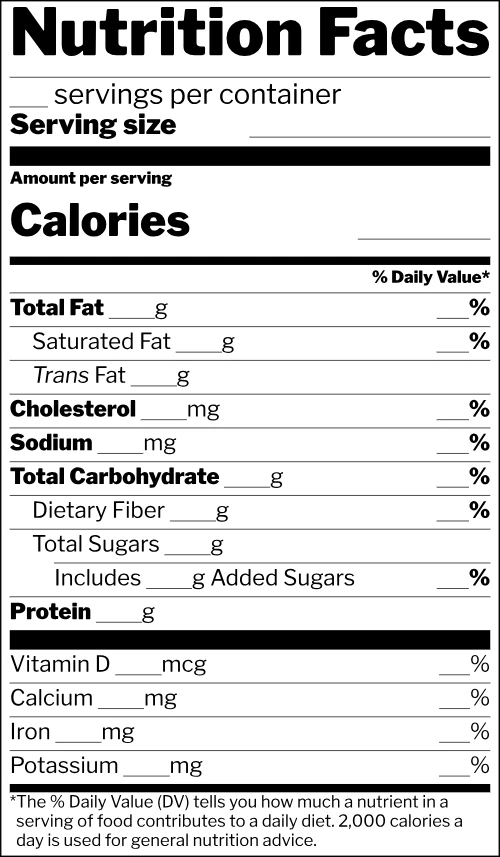
  • Blank nutrition facts label template, Standard vertical format

    Standard vertical

    The default vertical panel for most packaged food (21 CFR 101.9(d)).

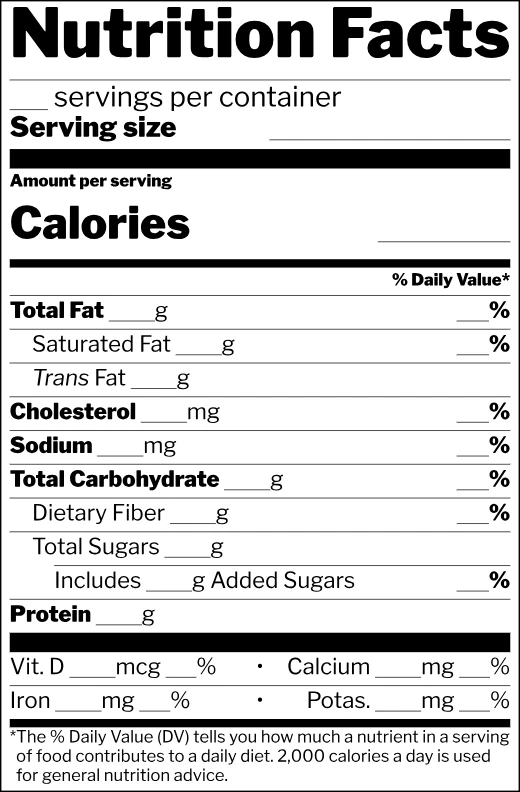
  • Blank nutrition facts label template, Vitamins side by side format

    Vitamins side by side

    The vertical panel with vitamin and mineral lines paired to save height (101.9(d)(8)).

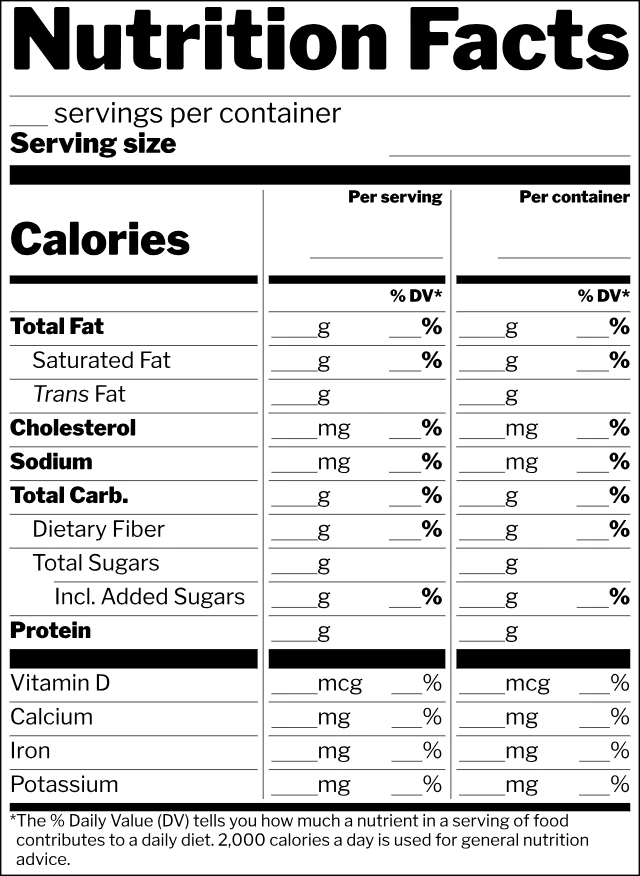
  • Blank nutrition facts label template, Dual column (per container) format

    Dual column (per container)

    Per serving and per package columns, required for 200% to 300% of the reference amount (101.9(b)(12)).

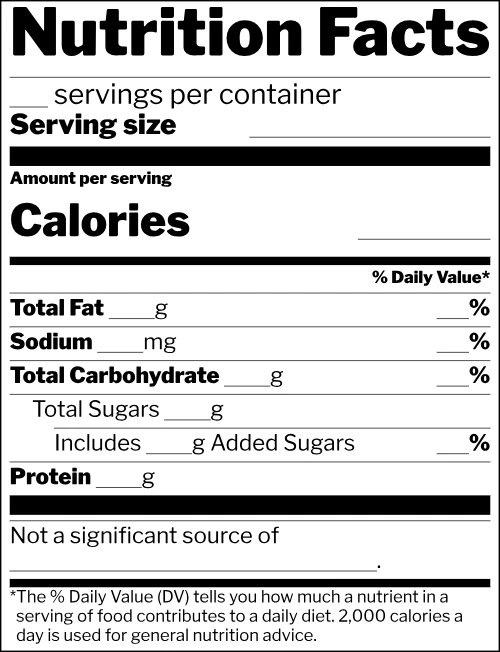
  • Blank nutrition facts label template, Simplified format

    Simplified

    For foods with insignificant amounts of 8 or more of the 15 core nutrients (101.9(f)).

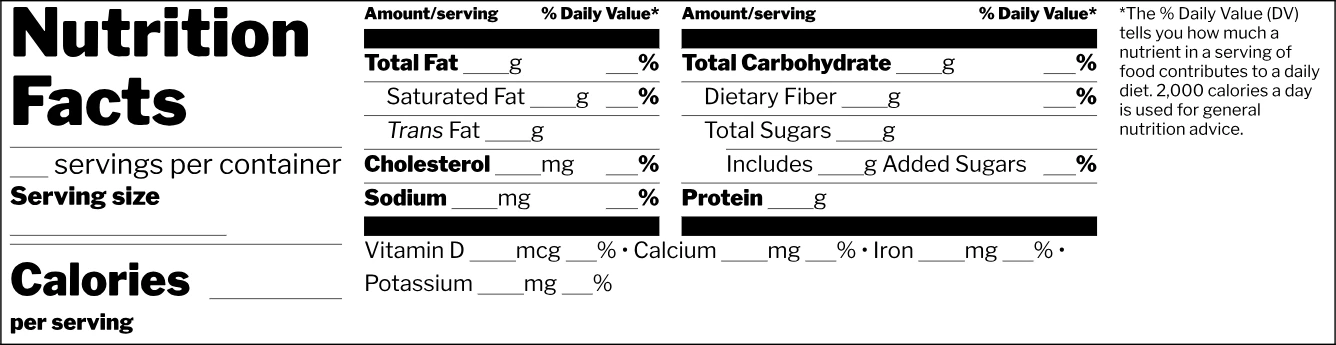
  • Blank nutrition facts label template, Tabular format

    Tabular

    For panels with less than about 3 in of continuous height (101.9(d)(11)(iii)).

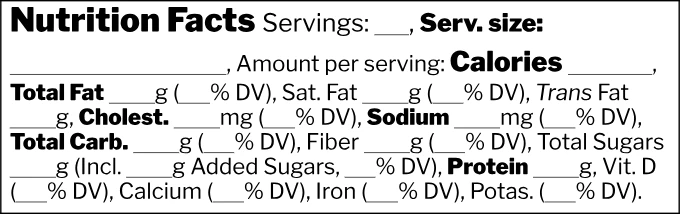
  • Blank nutrition facts label template, Linear format

    Linear

    For packages with 40 sq in or less when no other format fits (101.9(j)(13)(ii)(A)).

Classroom sheet: two large blank labels on a page

Standard labels printed at one and a half times their size, with room to write each number by hand, for a lesson on reading or inventing a food label.

Fill in a template

Enter your servings, serving size and amounts. The values are rounded to FDA rules, the % Daily Values are worked out for you, and the checks tab flags what doesn’t add up.

Label format

Serving

servings

8 servings per container

g

Nutrients per serving

Enter actual amounts from your lab test or recipe analysis. The label rounds them by FDA rules; the right column shows what it will print.

230
kcal

From fat, carbohydrate and protein: about 216 to 232 kcal.

8g · 10%
g
1g · 5%
g
0g
g
0mg · 0%
mg
160mg · 7%
mg
37g · 13%
g
4g · 14%
g
12g
g
10g · 20%
g
3g
g
2mcg · 10%
mcg
260mg · 20%
mg
8mg · 45%
mg
240mg · 6%
mg

Size and color

in
Type color
#
Background
#

Loading the label fonts…

Vector · outlined text · 100% K black
Saved in this browser
  • Free, no limits
  • No sign up needed
  • No watermark
  • Saved only where you choose

FDA does not approve food labels before they are sold. This template follows FDA’s format and type size rules; the numbers you put in it, and whether your package may use the format, are up to you.

FDA formats, blank or with sample values
6
file types: PDF, SVG, EPS and 300 dpi PNG
4
large blank labels on one classroom page
2
signups or watermarks
0

How to use this nutrition facts label template

Three steps take you from an empty panel to a finished label, whether you print the blank or fill it in on this page.

Standard vertical
Vitamins side by side
Dual column (per container)
Tabular
Linear
Simplified

A free nutrition label template drawn to FDA rules

Many blank labels online are clip art, with bars and type sizes that only look right. This nutrition facts label template is drawn by the same engine as our nutrition label generator, line by line from the regulation.

Specs
Nutrition Facts16+ pt¼ pt8 servings per container10 ptServing size2/3 cup (55g)10 pt7 ptCalories23016 · 22 pt3 ptTotal Fat 8g10%8 pt¼ ptSodium 160mg7%

Minimum sizes from 21 CFR 101.9(d)

Type sizes and rules from the regulation

A blank template keeps every nutrient name, unit, % sign, bar, rule and type size of the filled label and leaves only the numbers empty. On the standard label that means 8 point nutrients, a 16 point "Calories" with room for a 22 point number, 7-point bars and quarter-point hairlines. Every empty place is underlined, so it reads as a blank to fill.

Blank nutrition facts label template, Standard vertical formatStandard vertical
Blank nutrition facts label template, Vitamins side by side formatVitamins side by side
Blank nutrition facts label template, Dual column (per container) formatDual column (per container)
Blank nutrition facts label template, Simplified formatSimplified
Blank nutrition facts label template, Tabular formatTabular
Blank nutrition facts label template, Linear formatLinear

Six FDA formats, blank or as an example

Standard vertical, vitamins side by side, dual column, simplified, tabular and linear. The examples use FDA’s sample product, 8 servings of 2/3 cup at 230 calories; the dual column example is a pint of ice cream, the simplified one a 12 fl oz soda and the linear one a roll of mints.

Which label sheets each format fits on
Label sheetStandardSide by sideDual columnSimplifiedTabularLinear
OnlineLabels OL51003.5 in × 5 in, 4 per sheetFits3.25 in × 4.39 inFits3.25 in × 4.05 inFits3.25 in × 4.39 inFits3.25 in × 3.49 inDoes not fitFits3.25 in × 1.08 in
Avery 51644 in × 3.33 in, 6 per sheetDoes not fitDoes not fitDoes not fitFits3.08 in × 3.46 in (turned 90°)Does not fitFits3.75 in × 0.95 in
OnlineLabels OL82502 in × 5 in, 8 per sheetDoes not fitDoes not fitDoes not fitDoes not fitDoes not fitFits1.75 in × 1.97 in
Avery 51634 in × 2 in, 10 per sheetDoes not fitDoes not fitDoes not fitDoes not fitDoes not fitFits3.75 in × 0.95 in
Avery 228223 in × 2 in, 8 per sheetDoes not fitDoes not fitDoes not fitDoes not fitDoes not fitFits2.75 in × 1.23 in
Avery 228062 in × 2 in, 12 per sheetDoes not fitDoes not fitDoes not fitDoes not fitDoes not fitDoes not fit

Sized for common label sheets

A table shows which label sheets each blank format fits on at FDA’s minimum type sizes, with 1/8 inch kept clear inside the label and each label tried both ways round, so you know before you buy a pack of labels.

Which format can I use?
Reference amount (RACC)55g
Net contents165g

The package holds 300% of the reference amount.

Standard verticalVitamins side by sideDual column (per container) · required

200% to 300% of the reference amount: a dual column label, per serving and per package, is required.

A format helper for your package

The format you may use depends on the package, not only on the label. Enter the label area, the panel height and the reference amount in the editor, and it tells you when tabular or linear is allowed and when a dual column label is required.

  • PDFvector, 100% K black
  • SVGvector, for design apps
  • EPSvector, for older workflows
  • PNG300 / 600 dpi

Free vector files, no signup

Every format downloads straight from its card, with no signup and no watermark. Text is converted to outlines so the printer needs no fonts, the PDF and EPS print black as 100% K, and the PNG is 300 dpi at the label’s true size.

Does FDA offer a nutrition facts label template?

No. On its industry resources page for the label changes, FDA answers the question directly: "FDA has not provided label templates in the past and we do not plan to do so now." It suggests that companies use its sample labels and graphic illustrations as visual guides when they format their own labels, and adds that the private sector is equipped to provide labeling templates.

The label images FDA offers for download are not a template either. That page says: "For educational purposes only. These labels do not meet the labeling requirements described in 21 CFR 101.9." The templates on this page are built from the paragraphs of 21 CFR 101.9 and the graphic specifications FDA recommends in Appendix B to Part 101. FDA does not approve labels before sale, so no template is "FDA approved": the format and type sizes are handled here, and the numbers are your responsibility.

Checks2
  • Added sugars (13 g) cannot be more than total sugars (12 g). 21 CFR 101.9(c)(6)(iii) ↗
  • At 300% of the reference amount, the label must be dual column: per serving and per package. 21 CFR 101.9(b)(12)(i) ↗

Always applied by this generator

  • FDA rounding for every amount and %DV
  • No %DV for trans fat and total sugars
  • Bold only where the rule allows it

Which blank nutrition facts label format to use

The standard vertical label is the default for most packaged food (101.9(d)). The vitamins side by side version puts vitamin D with calcium and iron with potassium on two lines to save height (101.9(d)(8)). A package that holds 200% to 300% of the reference amount, such as a pint of ice cream, must show a dual column label with one column per serving and one for the whole package (101.9(b)(12)(i)). The simplified format is for foods with insignificant amounts of eight or more of the 15 core nutrients, such as a soda (101.9(f)).

If the panel has less than about 3 inches of continuous height, the tabular format is allowed (101.9(d)(11)(iii)). A package with less than 12 square inches of label area, or with 40 square inches or less when no panel can hold a standard vertical label, may use the tabular format, and the linear format only when tabular will not fit either (101.9(j)(13)(ii)(A)). So the right format depends on your package, not on the label sheet; the format helper in the editor below works it out from your measurements.

< 12 sq in
No label needed without claims (print a phone or address)
≤ 40 sq in
If a standard label fits on no panel: tabular, then linear
< 3 in
Height under about 3 in: tabular
200 to 300% RACC
Dual column per serving and per package, required

What size to print a nutrition facts label template

FDA sets minimum type sizes, not a minimum label size. On the standard label, nutrient lines must be at least 8 point, "Calories" at least 16 point and its number at least 22 point, with smaller minimums for the tabular and linear formats (101.9(d)(1)(iii)). At those sizes, the smallest each blank can be, width by height, is 2.18 × 4.23 inches for the standard template, 2.56 × 3.95 for vitamins side by side, 3.07 × 4.36 for dual column and 2.18 × 3.21 for simplified. The tabular template takes its size from its content, 6.68 × 1.73 inches, and the linear one starts at 1.76 × 2.09 inches and gets shorter as it gets wider.

On label sheets, with 1/8 inch kept clear inside each edge (the safe area of the food label maker) and the label tried both ways round, a 3.5 × 5 inch OnlineLabels OL5100 label takes the standard, side by side, dual column, simplified and linear templates. A 4 × 3 1/3 inch label compatible with Avery® 5164 takes the linear one, and the simplified one only turned 90°, while OnlineLabels OL8250 and labels compatible with Avery 5163 and 22822 take only the linear one. A 2 × 2 inch label compatible with Avery 22806 is too small for any of them, and the tabular template is too wide for all of these sheets. The table measures each format filled in with typical values, so a long serving size or extra vitamins may need more room.

Smallest size of each blank template
FormatSmallest size (width × height)
Standard vertical2.18 in × 4.23 in
Vitamins side by side2.56 in × 3.95 in
Dual column (per container)3.07 in × 4.36 in
Simplified2.18 in × 3.21 in
Tabular6.68 in × 1.73 in
Linear1.76 in × 2.09 in

How to fill in a blank nutrition facts label

Every number on the label is rounded by its own FDA rule, so copying amounts from a lab report onto a blank by hand is where most mistakes happen. Calories round to the nearest 5 up to 50 and to the nearest 10 above. Fats round to 0.5 g under 5 g and to 1 g above. Sodium rounds to 5 mg up to 140 mg and to 10 mg above. The % Daily Value compares each amount with its Daily Value, such as 78 g for total fat or 2,300 mg for sodium, and vitamins and minerals use 2%, 5% and 10% steps.

That is why each card has Fill in this template. It opens the editor below in that format, starting from FDA’s sample values (Clear empties them). Enter the servings, the serving size and the actual amounts per serving: the values are rounded, the % Daily Values worked out, and the Checks tab flags anything that does not add up, citing 21 CFR 101.9. Your label is saved in this browser; save a project file, or sign in and choose Save to account, to open it elsewhere.

The editor makes English labels for adults and children 4 years and over. Labels for infants, children 1 to 3 years and pregnant or lactating women use other Daily Values and are not supported yet. If you fill in a printed blank by hand or in another program instead, keep the printed units and % signs, use the same rounding rules and set each value at no less than the template’s type sizes.

Math
  • Calories47 kcal → 45

    up to 50 kcal: nearest 5

  • Saturated Fat0.4 g → 0g

    under 0.5 g shows as 0

  • Cholesterol3 mg → <5mg

    2 to 5 mg shows as "less than 5mg"

  • Sodium146 mg → 150mg · 7%

    over 140 mg: nearest 10 mg

  • Iron1.3 mg → 1.3mg · 8%

    1.3 mg ÷ 18 mg = 7.22%, nearest 2%: 8%

Using the nutrition label template in Word, Canva or Illustrator

Word in Microsoft 365 can insert the SVG or the PNG, and Google Docs and Canva take the PNG, which is 300 dpi, so it prints sharp at its real size. Illustrator, InDesign and Inkscape open or place the PDF, EPS or SVG, the vector files a packaging printer wants.

The text in every file is converted to outlines, so the printer needs no fonts, but it also means the words and numbers cannot be retyped inside the file. Fill in the template here first and download the finished label, or set your own text in the blank places at no less than the template’s type sizes. Place the label at its true size and never scale it down, or the type falls below FDA’s minimums.

Print file check
  • Color: 100% black (K), one plate
  • Text outlined: the printer needs no fonts
  • Actual size: 2.50 × 4.30 in
  • No watermark, free to use on your products
C 0%M 0%Y 0%K 100%

Blank nutrition facts label sheets for the classroom

Teachers use a blank nutrition facts label for lessons on reading food labels: students copy the numbers from a real package and compare serving sizes, calories and % Daily Values. Another favorite is to invent a food, fill in its label and explain each line.

The classroom sheet prints two blank standard labels at one and a half times their size on one Letter or A4 page, so each number has room to be written by hand. For a cereal box book report, pair it with the cereal box template: students fill in a label for their cereal and glue it on the box they made.

A printable page of two large blank nutrition facts labels
Two large blank labels on one Letter or A4 page

Do cottage foods need a Nutrition Facts label?

Usually not. Most states do not ask for a Nutrition Facts panel on cottage food unless the label makes a nutrition claim such as "low fat" or "sugar free". State rules vary, so check yours; the cottage food label maker sets up the label for your state.

Stores often ask for a label anyway. When you need one, fill in this template with numbers from a lab or a recipe analysis, then choose Put on a food label under the editor’s downloads. The finished panel opens in the free food label maker, where Design with AI can paint the label’s artwork around the exact panel, using credits.

  1. 1Any nutrient claim or other nutrition information on the label, in labeling or in ads?

    YesFull Nutrition Facts label
    No
  2. 2Selling direct to consumers, with sales of $500,000 or less a year, or food sales of $50,000 or less?

    YesExempt: small retailer
    No
  3. 3Fewer than 100 full time equivalent employees, and fewer than 100,000 units of this product sold in the US a year?

    YesExempt: low volume, with a notice to FDANo notice needed with fewer than 10 employees and fewer than 10,000 units, unless you import the food.
    No
None of theseNutrition Facts label required

States and stores can still ask for a label. Source: 21 CFR 101.9(j)(1) and (j)(18), eCFR as of 6 October 2026.

Who uses a blank nutrition facts label

From a first production run to a classroom lesson, a ready blank saves drawing the panel from scratch.

Small food brands

Plan the pack around a blank template while the lab tests your product, then fill it in, put it on a food label and let AI design the artwork around it.

Bakeries and farmers market sellers

Print a simplified or standard label when a store asks for one, even if your sales are under the exemption line.

Packaging designers

Drop an outlined, true size vector panel into the artwork and keep room for it from the first sketch.

Teachers and students

Print two large blank labels on a page for a lesson, or put the PNG into Google Docs or Canva for a class project.

Nutrition facts label template FAQ

More questions? The Checks tab in the editor explains each problem with a link to the rule.

Choose a format

Is this nutrition facts label template free?

Yes. Every format, blank or example, and every file type is free, with no signup, no watermark and no limit, and you can use the labels on products you sell.

Does FDA provide a nutrition facts label template?

No. FDA says it "has not provided label templates in the past" and does not plan to, and the label images it offers are "For educational purposes only" and do not meet 21 CFR 101.9. Use FDA’s sample labels as visual guides, or a template drawn to the rules like this one.

Is a blank nutrition facts label FDA approved?

No label is. FDA does not review or approve food labels before they go on sale; the company that sells the food is responsible for them. This template follows FDA’s format and type size rules, and the numbers you put in it are up to you.

Can I edit the nutrition facts label template in Word?

Word in Microsoft 365 can insert the SVG or the PNG, but the text in the files is outlined, so you cannot retype it there. Fill in your values on this page first and download the finished label, or type your own text in the blank places at no less than the template’s type sizes.

How small can a nutrition facts label template be?

FDA sets minimum type sizes rather than a minimum label size. At those sizes the standard blank is at least 2.18 inches wide and 4.23 inches tall, and the size table on this page lists every format. Small packages may qualify for the tabular or linear format; never scale a downloaded label below its size.

Which label sheets fit a blank nutrition facts label?

A 3.5 × 5 inch label such as OnlineLabels OL5100 takes every format but tabular. A 4 × 3 1/3 inch label compatible with Avery® 5164 takes linear, and simplified turned 90°. Narrower labels, such as a 2 × 5 inch OnlineLabels OL8250 or a 4 × 2 inch label compatible with Avery 5163, take only linear; a 2 × 2 inch label takes none, and the tabular format is too wide for all of them.

Can students use a blank nutrition facts label for homework?

Yes. The classroom sheet prints two blank standard labels at one and a half times their size on a Letter or A4 page, big enough to fill in by hand, for lessons on reading labels or for a label of a food students invent.

Is there a Spanish or bilingual nutrition label template?

Not yet. The templates and the editor make English labels. If a pack uses another language anywhere, 21 CFR 101.15 requires all mandatory information in both languages, so a bilingual pack needs a translated Nutrition Facts panel as well.

Get your nutrition facts label template

Pick one of the six FDA formats, download it blank or as an example, or fill in your numbers for a print-ready label. It is free, with no signup.