
What Is a Dieline? Meaning and Examples
What is a dieline? The flat outline of a package that shows where to cut, fold and glue. See what each line means and how to check a dieline before printing.
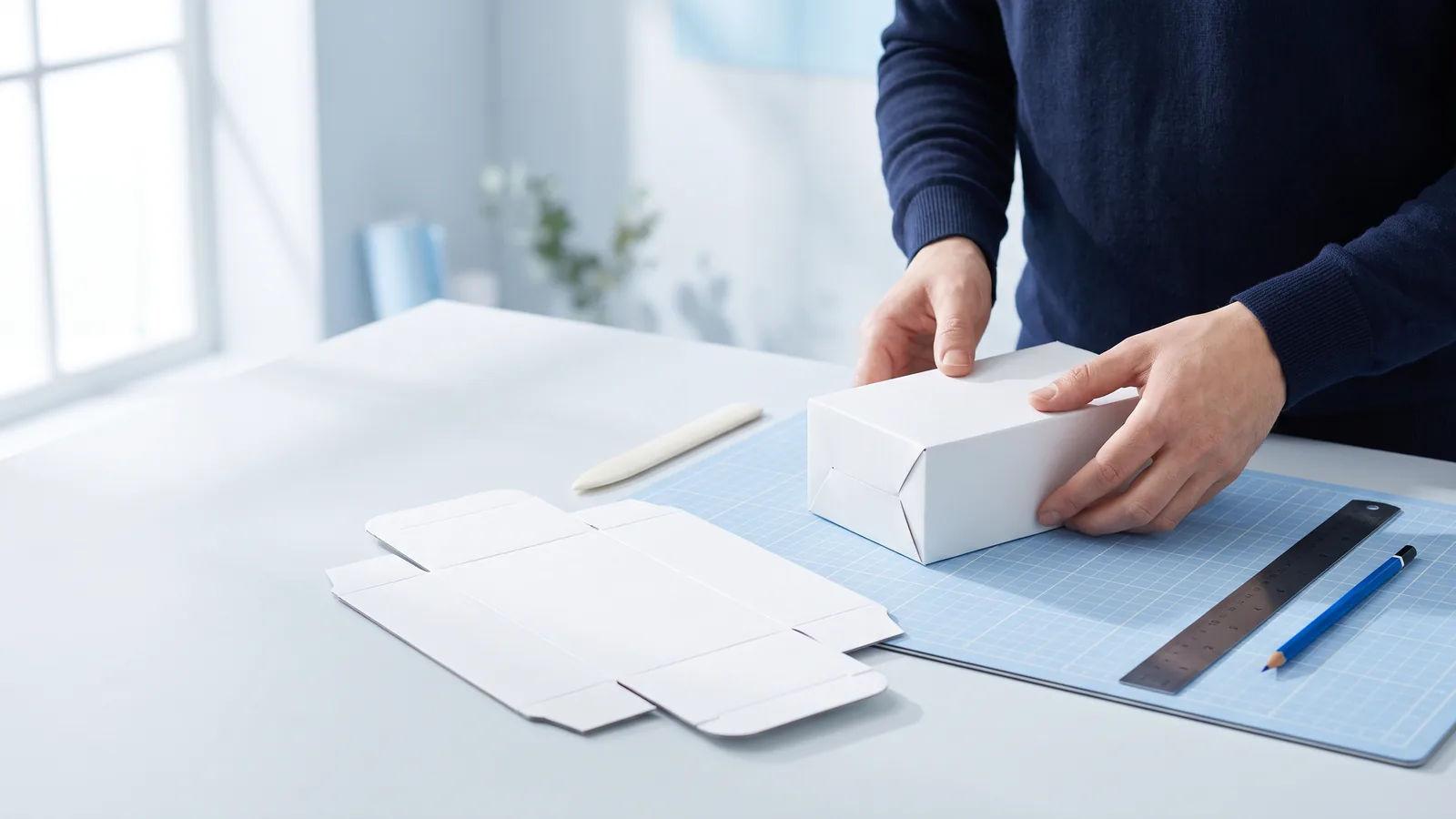
What is a dieline? A dieline is the flat, unfolded outline of a package that shows exactly where the material will be cut, folded and glued. Printers, die makers and cutting machines all work from it, and designers place their artwork on top of it so the graphics land on the right panels once the box is folded. If you have ever taken a cereal box apart and laid it flat, the shape in front of you is what a dieline describes.
You can draw a dieline for any size and style of box with the free dieline generator, or start from a printable box template. This guide explains the dieline meaning, what every line on it does, and how to check one before you print.
Dieline meaning
The word comes from die cutting. In carton production a die is a cutting tool: steel cutting rules and blunter creasing rules set into a board, shaped like the outline of the package. The die presses through a printed sheet and cuts out the box shape while creasing the folds in one pass. The drawing that the die is built from is the die line.
You will see it written as dieline, die line and die-line. All three mean the same thing; dieline as one word is the most common spelling in packaging design today. It is not "dyeline": a dyeline is an old diazo copying process for drawings and has nothing to do with packaging.
What a dieline shows
A production dieline is a technical drawing at 1:1 scale. Each kind of line has its own meaning, and printers usually expect each one on its own layer and in its own spot color so a machine or an operator can tell them apart.
- Cut lines (usually solid) mark where the knife cuts through the board, including slits, tuck locks and thumb notches.
- Crease or fold lines (usually dashed) mark where the board is scored so it folds cleanly.
- Perforations are cut and tie lines, for tear strips and easy opening features.
- Glue areas show where glue goes; they stay free of ink and varnish so the glue can hold.
- Bleed is the area outside the cut line that the artwork should run into, typically 1/8 in or 3 mm, so a small shift in cutting never leaves a white edge.
- Safe area is a margin inside the folds and cuts where text and logos stay, so nothing important is cut off or lost in a fold.
- Dimensions and notes give the size, the board, the style and anything the printer should know.

The dieline itself is never printed on the finished package. Its layers are set to overprint so they sit above the artwork without knocking it out, and the printer switches them off for the press run.
How a dieline works in production
- Measure the product. The box is sized from the inside dimensions the product needs, plus a little clearance.
- Choose a structure. A reverse tuck end, a straight tuck end, a box with a lid, a drawer box and so on. Standard folding carton styles have codes in the ECMA Code of Folding Carton Design Styles, such as A20.20.03.01 for a reverse tuck end, which printers recognize (see sources).
- Draw the dieline. Panel sizes allow for the board thickness, which is measured in points (1 pt = 0.001 in; 18 pt board is common for folding cartons). Flaps, tucks and glue tabs get their own shapes.
- Place the artwork. The designer puts the graphics on the dieline file, extends them into the bleed and keeps text inside the safe area.
- Make the die or set up the cutter. Large runs use a steel-rule die built from the dieline. Short runs and samples are cut on a digital cutting table, and at home a Cricut or Silhouette cuts and scores from the same outline.
- Print, cut, fold and glue. The sheet is printed, die cut and creased, then folded and glued into a flat carton ready to be filled.
Dieline vs artwork, and what a keyline is
The dieline is the structure; the artwork is everything printed on it. A single dieline can carry many artwork versions, such as flavors or seasonal designs, as long as the box size stays the same. That is why designers keep the dieline on its own locked layer and never merge it with the graphics.
A keyline is a thin, non-printing outline that marks where something goes. Some printers use keyline to mean the dieline itself; others use it for any guide outline, such as the window of a box or the position of a photo. If a printer asks for a keyline on a packaging job, ask whether they mean the full dieline or a single outline.
Common box dielines
- Reverse tuck end: the classic retail carton for cosmetics, cards and small goods; the top and bottom closures fold from opposite sides.
- Straight tuck end: both closures fold from the back, the style of a cereal box template.
- Box with lid and drawer box: two pieces, a base and a lid or a tray and a sleeve, for gifts and jewelry.
- Closed cube: six panels and glue tabs, as in a paper cube template for classrooms and dice.
- Blind box: a small tuck end box sized to a figure, like a blind box template.

How to create a dieline
You can get a dieline in three ways:
- Ask your printer. Most packaging printers send a dieline for the box size and board they will use. This is the safest choice for a production run.
- Draw one yourself in Illustrator or another vector editor, with separate layers for cut, crease, bleed and safe lines. It takes care to get the board thickness and the tuck clearances right.
- Generate one for free. The dieline generator draws reverse and straight tuck end boxes, boxes with lids, drawer boxes and closed cubes from your measurements, allows for the board thickness, checks the result and exports PDF, SVG, DXF, PNG and Cricut files.
A worked example: a poker card box
To show what the numbers look like, we drew a reverse tuck end box for a standard poker deck in the dieline generator, using its poker preset on 18 pt SBS board. These are the values the tool reported, as length × width × depth:
- Inside: 2.56 × 0.75 × 3.56 in, the space the deck needs plus a little clearance.
- Crease to crease: 2.58 × 0.77 × 3.60 in. The folded board takes up some of the space, so each panel grows by part of the board thickness and the box still closes around the deck.
- Outside: 2.60 × 0.79 × 3.61 in, the size of the finished box.
- Flat size: 7.17 × 6.05 in, so the whole dieline fits on one US Letter or A4 sheet with room for bleed.
- Line lengths: 31.25 in of cut line and 25.99 in of crease line, the lengths of steel rule a die needs.
- Pieces: 13 faces: four body panels, a glue flap, two closure panels with their tucks, and four dust flaps.
- Checks: the tool's checks flagged nothing for this size and board.
On thinner paper the same inside size gives smaller crease and outside sizes, which is why a dieline is always drawn for one board.

Check your dieline before you print
- Print it at 100% and measure the scale square or a known dimension.
- Cut it out of plain paper or card and fold a mockup to see that the product fits and the panels face the right way.
- Make sure cut and crease lines are on separate layers, in spot colors, set to overprint.
- Extend background artwork into the bleed, and keep text and barcodes inside the safe area.
- Leave glue areas free of ink and varnish.
- Confirm the board and its thickness with your printer, since the panel sizes depend on it.
Dieline FAQ
What does dieline mean? It is the flat outline of a package that shows where to cut, fold and glue, named after the cutting die built from it.
Is dieline one word or two? Both are used; dieline as one word is the usual spelling in packaging.
What is a box die line? The dieline of a box: the unfolded shape of the carton with its cut lines, fold lines and glue flaps.
Is a keyline the same as a dieline? Sometimes. Some printers use the words interchangeably, while others use keyline for any non-printing guide outline.
How do I get a free dieline? Ask your printer, start from a box template, or make one to your size with the dieline generator.
Sources
- ECMA (European Carton Makers Association), The ECMA Code of Folding Carton Design Styles, ecma.org. Style A20.20.03.01 is the folding box with a longitudinal seam and offset tuck-in flaps, the reverse tuck end. Code checked on 2026-10-08 against Packaging Warehouse, "ECMA Codes: what do the abbreviations mean?".
- The poker box values: the dieline generator, poker preset, 18 pt SBS, run on 2026-10-08.